
Updated Sep 24, 2026
Debt Snowball vs. Avalanche in Notion: Which Pays Off Debt Faster
The debt avalanche method (highest interest rate first) saves you the most money in total interest paid. The debt snowball method (smallest balance first) usually gets your first payoff sooner, which is what keeps people paying more than the minimum. Neither approach is wrong — a Notion debt tracker can compute both automatically from your own numbers.
What is the debt snowball method?
List every debt, pay the minimum on all of them, and send every extra dollar to whichever one has the smallest balance, regardless of its interest rate. Once that debt is gone, roll its entire old payment (minimum plus whatever extra you were sending) into the next-smallest balance. Debts disappear one at a time, fastest ones first. That's the whole point: each payoff is a visible win that keeps the habit going instead of feeling like a decade of nothing changing.
What is the debt avalanche method?
Same mechanic, different order. Pay the minimum on everything, then send every extra dollar to whichever debt has the highest APR, regardless of its balance. Once that's paid off, move to the next-highest rate. Mathematically, this is the cheapest way to clear multiple debts: you stop the most expensive balance from growing first, which is where you're losing the most money every month it sits there unpaid.
Snowball vs. avalanche: a worked example
Take five of the six debts from the Debt Payoff Planner template's own sample data (the sixth exists just to test a stuck-debt edge case, so it's left out here to keep the example clean):
| Debt | Balance | APR | Min. payment |
|---|---|---|---|
| Personal loan | $500 | 9.99% | $50 |
| Store card | $850 | 26.49% | $35 |
| Visa card | $3,200 | 22.99% | $95 |
| Car loan | $9,400 | 6.90% | $285 |
| Student loan | $18,500 | 4.50% | $190 |
Snowball order (smallest balance first): Personal loan, Store card, Visa card, Car loan, Student loan.
Avalanche order (highest APR first): Store card, Visa card, Personal loan, Car loan, Student loan.
The store card and Visa card come first either way here, since they happen to be both small and expensive. The real disagreement is the personal loan: snowball wants it first because it's the smallest balance by far, while avalanche pushes it to third, since a 9.99% rate (not cheap, but well under the two cards above it) costs less each month than either card does.
How do you automate both methods in Notion?
- Add each debt to a Debts database with its Starting balance, APR and Minimum payment.
- Log every payment in a Payments database, linking each one to the right debt (and, if you're budgeting month to month, the right month too).
- Let Balance recalculate itself from what you've actually paid, rather than re-typing it after every payment:
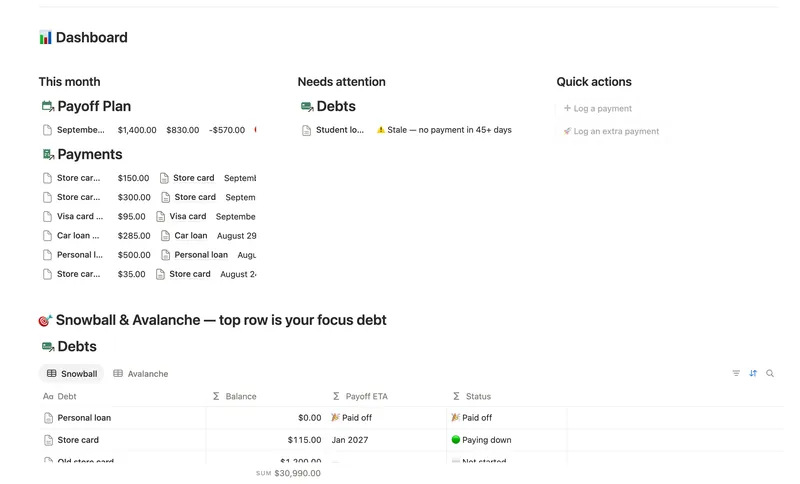
max(prop("Starting balance") - prop("Paid"), 0)- Build two views on Debts: one sorted by Balance ascending (your snowball order), one sorted by APR descending (your avalanche order). Whichever method you're following, the top row in that view is your focus debt — every extra dollar goes there.
- Once a debt's Balance hits $0, a Status formula flips to something like "🎉 Paid off," which tells you that debt's old minimum payment is now free to roll into whichever debt is on top of your chosen list.
Which method actually pays off debt faster?
For a fixed extra-payment amount, the difference in total months to debt-free between snowball and avalanche is usually small — often a matter of weeks, sometimes a couple of months, depending on how your balances and rates line up. The difference in total interest paid can be real money, and it always favors avalanche, since it's mathematically the order that minimizes interest by construction. Snowball's advantage isn't math, it's follow-through: a debt disappearing in month three instead of month eleven is a concrete reason to keep sending extra dollars instead of letting "extra" quietly become "optional." If you're confident you'll stick with a plan either way, avalanche is the cheaper choice. If early wins are what keep the extra payments happening at all, that behavioral edge can be worth more than the interest math suggests.
Can Notion project when you'll actually be debt-free?
Yes, from an amortization calculation solved for months instead of payment amount. Here's a simplified version of the actual formula (the template's own version also guards against a blank or zero minimum payment, on top of one too small to ever cover the interest):
if(prop("Balance") <= 0, 0,
   if(prop("APR") == 0 or empty(prop("APR")),
      ceil(prop("Balance") / prop("Minimum payment")),
      ceil(-ln(1 - prop("Balance") * prop("APR") / 12 / prop("Minimum payment"))
           / ln(1 + prop("APR") / 12))))
The template caps this at 999 months for a debt whose minimum payment doesn't even cover its own interest — a real situation, and exactly the case the avalanche method exists to prevent from compounding further. Lifetime interest paid is tracked separately, based on how long you've actually been making payments, not on how many payments you've logged, so it doesn't inflate just because you split a payment into two smaller ones.
Is debt avalanche always the fastest way to get out of debt?
It's always the cheapest in total interest paid. It's usually close to the fastest in total time too, but not guaranteed — if your smallest balance also happens to carry an unusually high rate (a common pattern with store cards, which tend to be both small and expensive), snowball and avalanche can end up recommending nearly the same order anyway, as in the example above.
Should I switch methods partway through?
You can. Neither method changes anything about your debts themselves, only the order you attack them in — switching just means re-sorting the same view by a different column. If a debt's balance and rate happen to sit at the top of both lists (again, the store-card pattern), switching methods mid-plan barely moves anything.
Related: the Debt Payoff Planner runs both orders automatically from the same Debts and Payments data. Once a debt is cleared, Savings Goals gives the freed-up payment somewhere specific to go, and Net Worth Dashboard tracks the debt payoff's effect on your overall balance sheet over time. All three are part of the full 50-template bundle — $47 once, works on Notion's Free plan, lifetime updates.
Related templates
- 11 Debt Payoff Planner See every debt, its real interest cost and a projected debt-free date, then pay it down with the snowball or avalanche method — with a live focus-debt highlight and a payoff month that actually moves the moment you send extra dollars. 4 db · 26 formulas · 2 buttons
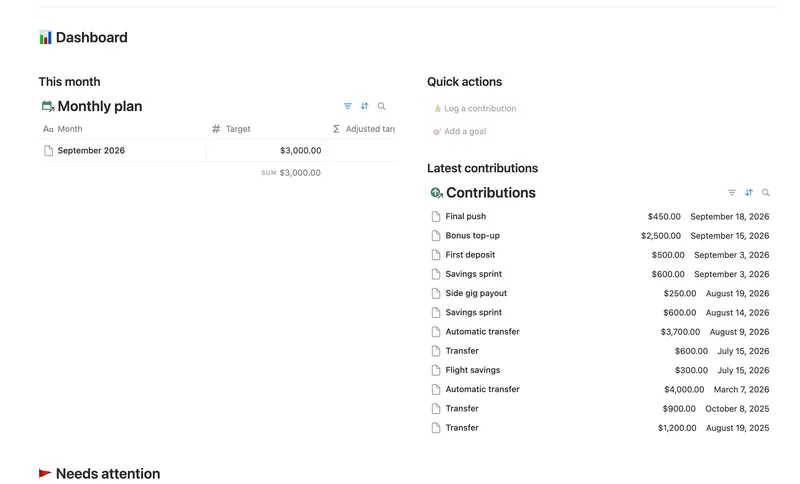
- 12 Savings Goals Fund multiple goals on a real schedule — know exactly how much each one needs this month, whether you're actually on pace to hit it, and which milestone is next. 5 db · 22 formulas · 2 buttons
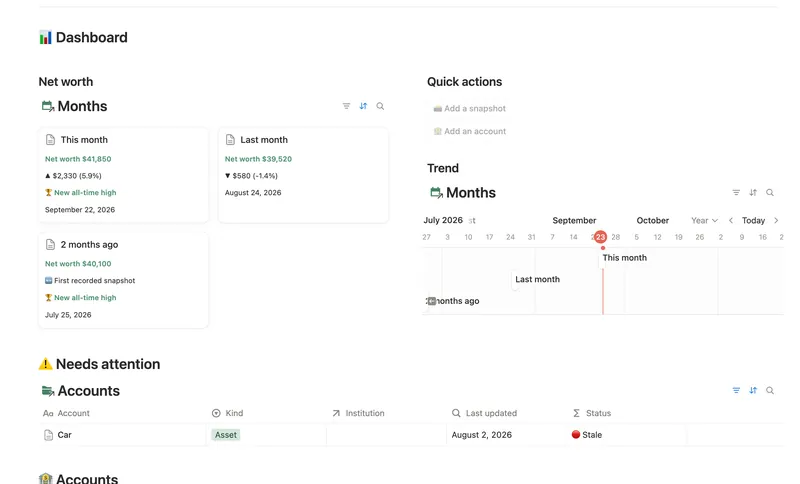
- 13 Net Worth Dashboard List everything you own and owe across every institution and asset class, and watch net worth compound month over month — with stale balances and allocation drift caught before they quietly skew the number. 5 db · 17 formulas · 2 buttons
§ The Bundle
Build it once, or start from a template
50 Notion templates, $197 value, $47 once.
One-time payment · Works on Notion Free · Instant Library access