
Updated Sep 24, 2026
§ Money
Notion Finance Templates
Money splits into two jobs: deciding where every dollar goes, and watching where it actually went. 50/30/20 Budget and Zero-Based Budget are two different ways to do the first job. Expense & Subscription Tracker, Net Worth Dashboard and Bills & Due Dates are for the second: after-the-fact visibility rather than a spending plan. Debt Payoff Planner and Savings Goals sit off to the side, each built around a single number you're working toward.
50/30/20 Budget and Zero-Based Budget solve the same problem differently, so pick one rather than running both: 50/30/20 splits each paycheck into three percentage buckets (Needs, Wants, Savings), while Zero-Based Budget assigns every dollar to a named Envelope before you spend it, with Carryover and Available balances tracked per envelope. Once a budgeting system is running, Expense & Subscription Tracker adds a second, independent read on where money actually goes by category and merchant, including subscriptions quietly going unused. Debt Payoff Planner and Savings Goals both work fine on their own, since each just needs its own numbers logged. Net Worth Dashboard and Bills & Due Dates are the two slowest-moving views: net worth month over month, and every bill's next due date and payment history.
If you've never budgeted before, 50/30/20 Budget is the simpler start; Zero-Based Budget is the better fit once you want every dollar assigned, not just categorized. If you don't want to change your spending yet and just want to see it clearly, start with Expense & Subscription Tracker. Add Debt Payoff Planner the moment you're carrying a balance you want gone, and Savings Goals the moment you're saving toward something specific rather than just accumulating. Bills & Due Dates is worth adding to any of the above the first time you miss a due date.
7 templates in Money
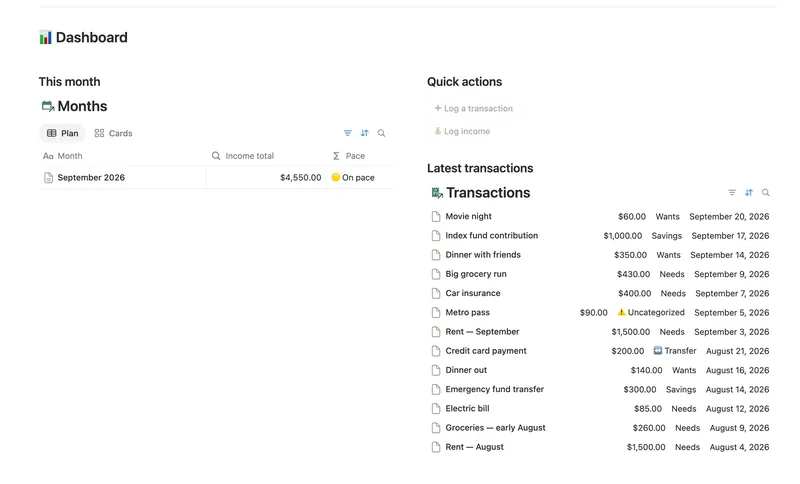
- 08 50/30/20 Budget Split every paycheck into Needs (50%), Wants (30%) and Savings (20%). Tag each purchase with a Category and its Bucket, its Month status and the whole dashboard fill in on their own. 5 db · 23 formulas · 2 buttons
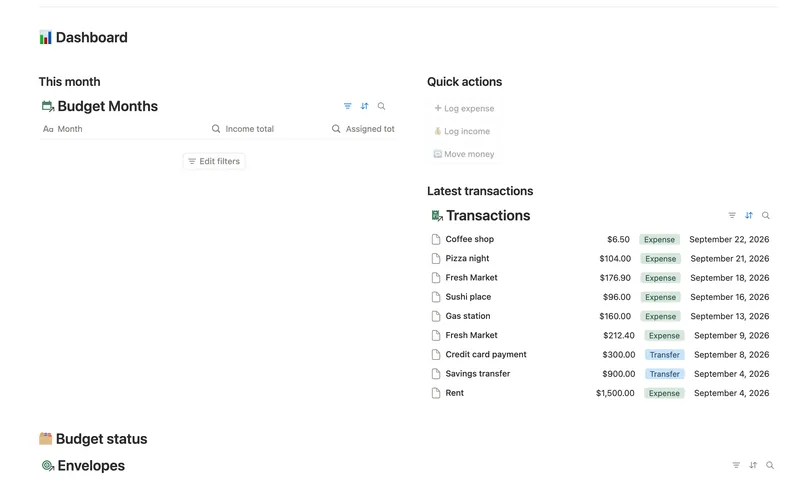
- 09 Zero-Based Budget Give every dollar a job before you spend it — Envelopes track Assigned, Carryover and Available in real time, Accounts keep a running Balance from your own transactions, and Budget Months shows exactly what's still To be assigned, all computed, never re-typed. 5 db · 17 formulas · 3 buttons
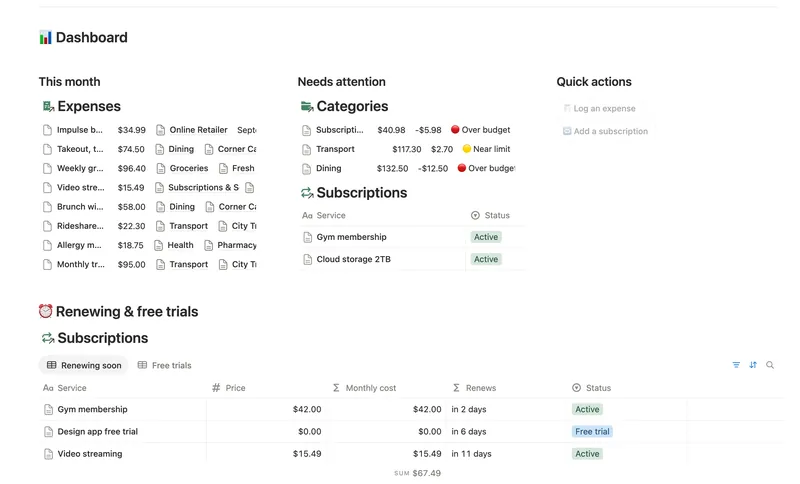
- 10 Expense & Subscription Tracker See exactly where your money goes — spending by category and merchant, every subscription's real monthly cost, and the ones quietly going unused. 5 db · 21 formulas · 2 buttons
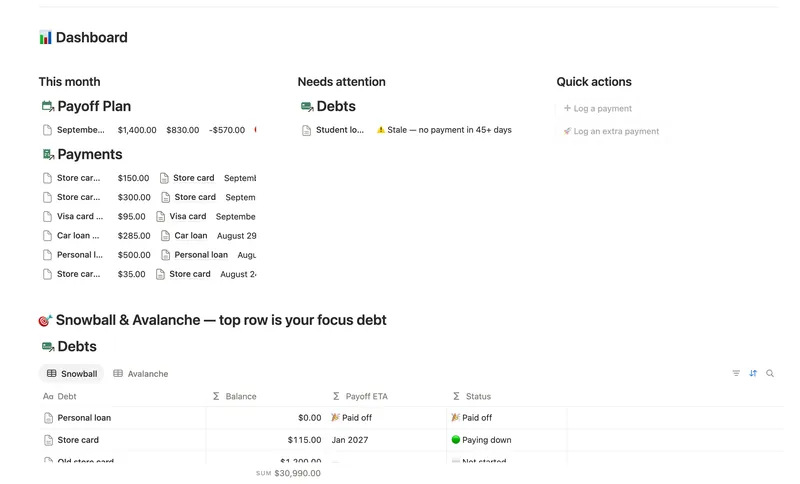
- 11 Debt Payoff Planner See every debt, its real interest cost and a projected debt-free date, then pay it down with the snowball or avalanche method — with a live focus-debt highlight and a payoff month that actually moves the moment you send extra dollars. 4 db · 26 formulas · 2 buttons
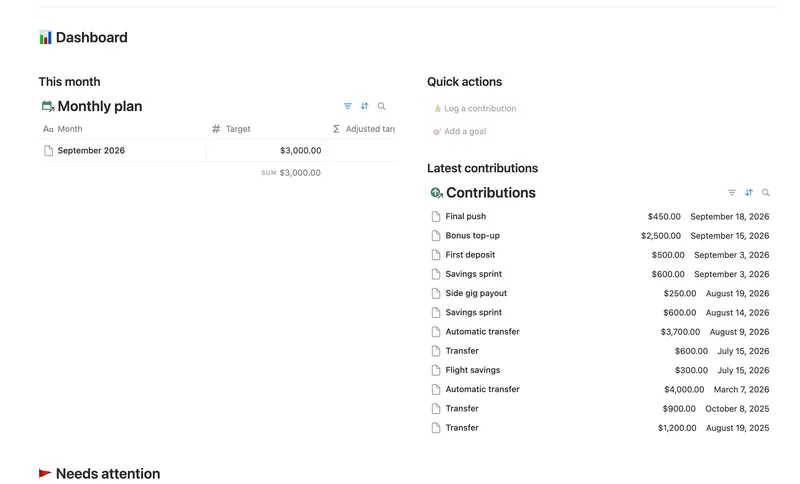
- 12 Savings Goals Fund multiple goals on a real schedule — know exactly how much each one needs this month, whether you're actually on pace to hit it, and which milestone is next. 5 db · 22 formulas · 2 buttons
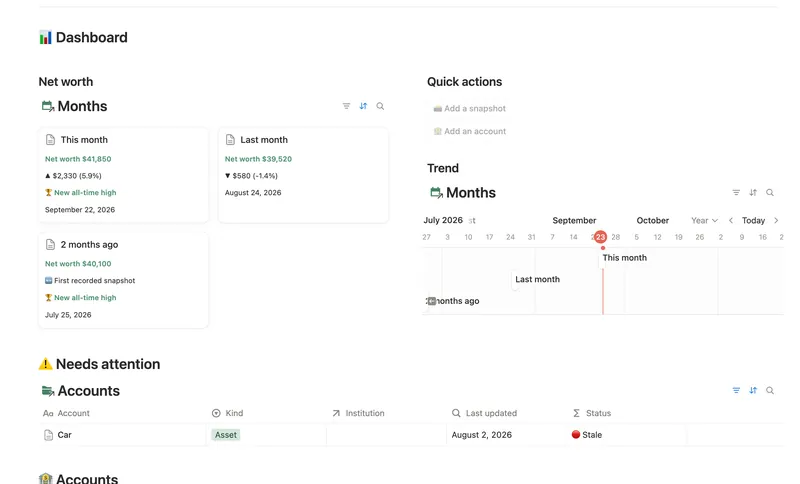
- 13 Net Worth Dashboard List everything you own and owe across every institution and asset class, and watch net worth compound month over month — with stale balances and allocation drift caught before they quietly skew the number. 5 db · 17 formulas · 2 buttons
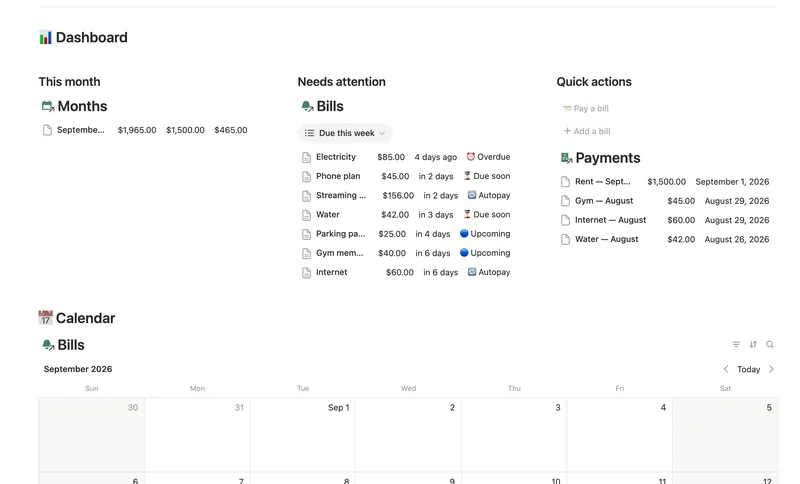
- 14 Bills & Due Dates Never miss a payment — every bill's next due date, its full payment history and which account it drains, computed automatically instead of retyped every cycle. 5 db · 11 formulas · 2 buttons
§ FAQ
FAQ
What Notion templates help manage money?
Seven, split into three jobs: budgeting (50/30/20 Budget, Zero-Based Budget), after-the-fact tracking (Expense & Subscription Tracker, Net Worth Dashboard, Bills & Due Dates), and goal-based saving or paydown (Debt Payoff Planner, Savings Goals). Most people run one budgeting template plus one or two of the trackers, not all seven.
Does Notion have a budget template?
Yes, two: 50/30/20 Budget splits paychecks into percentage buckets, and Zero-Based Budget assigns every dollar to an Envelope before you spend it. Both compute month-by-month status from your own Transactions instead of a running total you keep separately.
Can Notion track net worth and debt payoff together?
As two separate templates, yes: Net Worth Dashboard tracks everything you own and owe across every account and asset class month over month, and Debt Payoff Planner tracks what you owe specifically, with a projected debt-free date under either the snowball or avalanche method. There's no single template that combines both into one dashboard.
Can two people share the 50/30/20 Budget together?
Not as a built-in feature. 50/30/20 Budget tracks one person's Accounts, Categories and Transactions; there's no shared-couple mode or split-by-person view. Two people can still duplicate it into a shared Notion workspace and both add transactions, but the template itself doesn't distinguish who spent what.
Do the money templates work on Notion's Free plan?
Yes, all seven work on Notion's Free plan.
§ The Bundle
Get all 50, including every Money template
One payment, $197 value, lifetime updates.
One-time payment · Works on Notion Free · Instant Library access