
Updated Sep 24, 2026
Notion Budgeting Methods: 50/30/20 vs. Zero-Based (Which One Fits You)
The 50/30/20 rule splits your income into three percentages (50% needs, 30% wants, 20% savings) and suits people who want simple guardrails. Zero-based budgeting assigns every dollar a specific job before you spend it, and suits people who want tighter control. Both are straightforward to automate in Notion.
What is the 50/30/20 budgeting rule?
The 50/30/20 rule, popularized by Elizabeth Warren and Amelia Warren Tyagi's book All Your Worth, divides your after-tax income into three buckets: 50% on needs (rent, groceries, utilities, minimum debt payments), 30% on wants (dining out, streaming subscriptions, anything you'd miss but could live without), and 20% on savings and extra debt payoff. You don't track dozens of categories separately. You track which bucket each purchase falls into, then compare that bucket's total to its share of your income.
What is zero-based budgeting?
Zero-based budgeting works differently. Instead of percentage buckets, you assign every dollar of income to a specific category (rent, groceries, a vacation fund, extra debt payments) until nothing is left unassigned. "Zero-based" means Income minus Assigned equals zero, not that you spend everything down to nothing; money assigned to a savings category still sits in savings, it's just been given a job instead of floating as an undesignated number in your checking account. The categories in this method are usually called envelopes, after the old cash-envelope system it's modeled on.
50/30/20 vs. zero-based budgeting: which is better?
| 50/30/20 | Zero-based | |
|---|---|---|
| Setup time | Low — three buckets, done | Higher, one category per expense type |
| Best for | Guardrails without micromanagement | Knowing exactly where every dollar goes |
| What you track | Percent of income per bucket | Assigned vs. available, per category |
| Irregular expenses | A big annual bill blows out one bucket | Assign for it ahead of time, or use Carryover |
| Debt payoff | Comes out of the Savings bucket | Gets its own envelope, sized however you want |
Neither is strictly better. 50/30/20 takes fifteen minutes to set up and tells you, at a glance, whether you're spending too much on wants. Zero-based takes longer to configure and needs more frequent tending, but it catches things 50/30/20 can miss, like a subscription quietly eating 4% of your income inside the "wants" bucket without ever showing up as its own line.
How do you set up a 50/30/20 budget in Notion?
- Start from five linked databases: Accounts, Categories, Months, Income and Transactions.
- Give each Category a Bucket — Needs, Wants, Savings, or Transfer for money moving between your own accounts (paying off a credit card from checking isn't a new expense, so it gets its own bucket that nothing rolls up into).
- Log every purchase in Transactions and link it to an Account, a Category, and a Month. Category and Month are separate relations you set by hand — the quick-add button and the database's own templates can fill in a transaction's name and date, but neither can set a relation, so anything created that way needs tagging before it counts toward anything.
- Let the Bucket inherit itself. A Transaction never sets its own Bucket; it reads it from whichever Category you linked, so nothing gets accidentally counted as a Need when it's filed under a Wants category.
- Read a month's status off a formula instead of building your own spreadsheet cell.
Here's the actual formula behind a month's Needs status once transactions have rolled up into it:
ifs(
    prop("Elapsed %") <= 0, "⚪ Not started",
    prop("Income total") <= 0, "⚪ No income logged",
    prop("Needs spent") > prop("Income total") * 0.5, "🔴 Over budget",
    prop("Needs spent") > prop("Income total") * 0.4, "🟡 Near limit",
    "🟢 On track"
)
And "Needs spent" itself reads straight off the Transactions relation, filtered by Bucket, with no separate rollup property in between:
prop("Transactions")
  .filter(current.prop("Bucket") == "Needs")
  .map(current.prop("Amount"))
  .sum()
That's Notion's formula 2.0 syntax — a formula can filter and sum across a relation directly now, instead of needing a rollup as a go-between for every aggregation.
How do you set up a zero-based budget in Notion?
- List every account you spend from in Accounts, with its Opening balance.
- Create one Envelope per category you actually spend against (Rent, Groceries, Dining out, a savings goal) and set an Assigned amount for the month.
- Keep assigning until To be assigned reads $0. That figure is just Income total minus Assigned total:
prop("Income total") - prop("Assigned total")- Log every purchase in Transactions against its Account and Envelope. Available updates on its own:
prop("Assigned") + prop("Carryover") - prop("Spent")- Moving money between your own accounts (a credit card payoff, funding a goal) isn't spending. Set Type to Transfer with a Transfer to account, and leave Envelope empty; it updates both accounts' balances without touching any envelope's Spent total.
- At month end, move whatever's left in an envelope into Carryover before you roll the month over, or it's lost the moment the next month starts fresh.
Can you switch between the two, or use both at once?
You can run 50/30/20 for a few months to get a feel for your spending, then move to zero-based once you want finer control. Neither method locks you in, and starting a new template costs nothing. What you shouldn't do is track the same purchases in both: log a transaction in one budget template, not both, or you'll double-count every dollar that touches it.
Is zero-based budgeting better than 50/30/20?
Not universally. Zero-based catches more detail because every category is explicit, which matters if you've been surprised by where your money goes before. 50/30/20 costs less time to maintain, which matters if a detailed system is the reason your last three budgets didn't survive February. Pick based on how much upkeep you'll actually do, not which one sounds more rigorous.
Which budgeting method works best in Notion?
Both work fully in Notion — the difference is in the database shape, not the software. 50/30/20 needs one relation hop (Category → Bucket) rolled up a second time into Months. Zero-based needs a running Balance per account and a Spent formula that resets itself every calendar month. Both are built entirely from relations, rollups and formulas that work the same way on Notion's Free plan as on any paid tier.
Related: the 50/30/20 Budget and Zero-Based Budget templates cover the two methods above. Once you're budgeting, the Expense & Subscription Tracker adds a category-level budget-vs-actual view that goes past a 50/30/20 split, and the Debt Payoff Planner gives extra savings somewhere specific to go. All four ship as part of the full 50-template bundle — $47 once, works on Notion's Free plan, lifetime updates.
Related templates
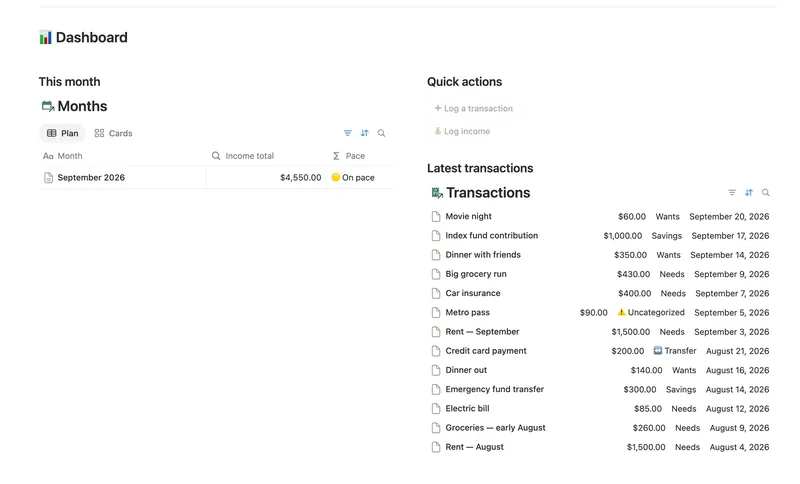
- 08 50/30/20 Budget Split every paycheck into Needs (50%), Wants (30%) and Savings (20%). Tag each purchase with a Category and its Bucket, its Month status and the whole dashboard fill in on their own. 5 db · 23 formulas · 2 buttons
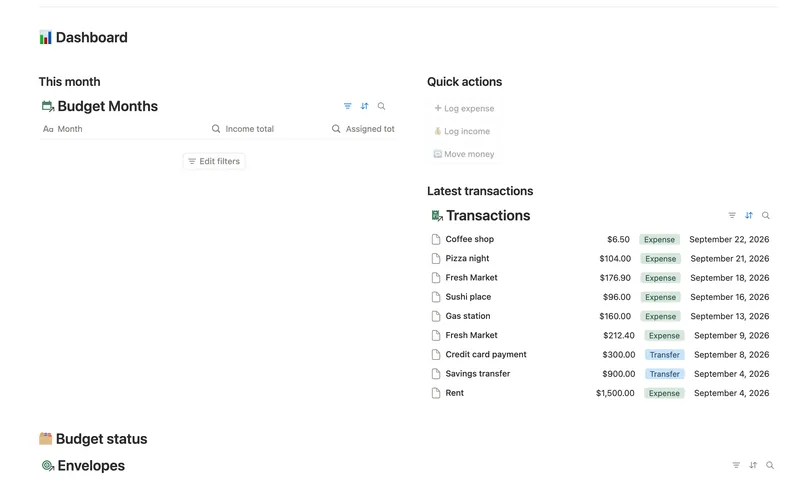
- 09 Zero-Based Budget Give every dollar a job before you spend it — Envelopes track Assigned, Carryover and Available in real time, Accounts keep a running Balance from your own transactions, and Budget Months shows exactly what's still To be assigned, all computed, never re-typed. 5 db · 17 formulas · 3 buttons
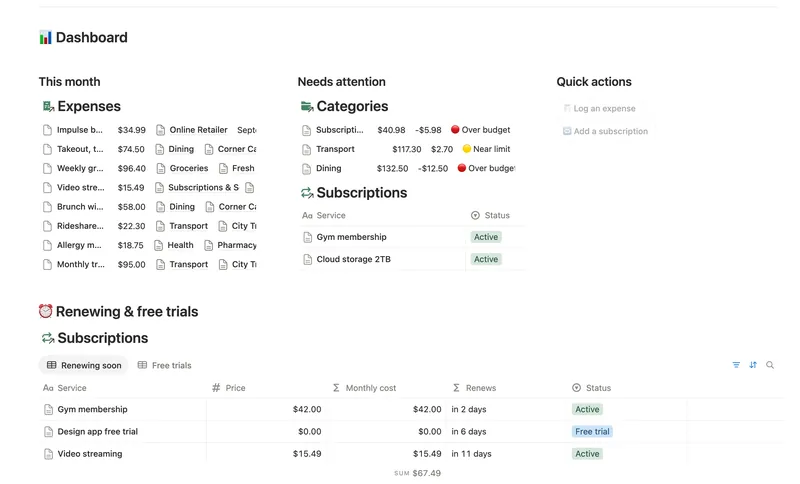
- 10 Expense & Subscription Tracker See exactly where your money goes — spending by category and merchant, every subscription's real monthly cost, and the ones quietly going unused. 5 db · 21 formulas · 2 buttons
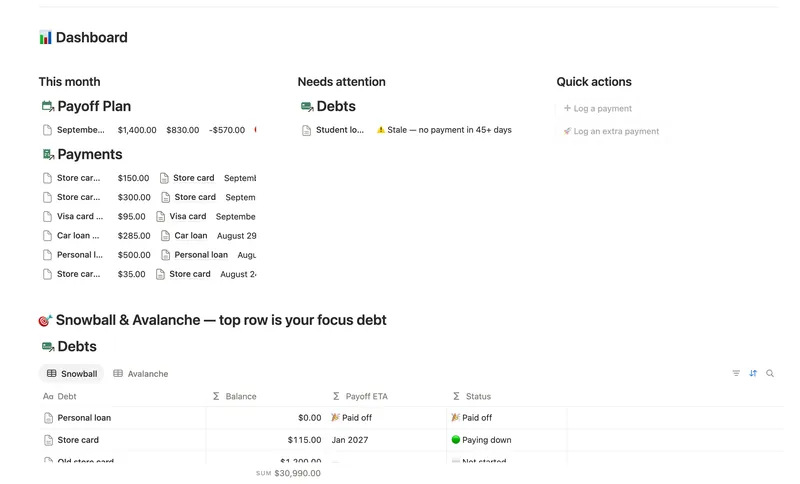
- 11 Debt Payoff Planner See every debt, its real interest cost and a projected debt-free date, then pay it down with the snowball or avalanche method — with a live focus-debt highlight and a payoff month that actually moves the moment you send extra dollars. 4 db · 26 formulas · 2 buttons
§ The Bundle
Build it once, or start from a template
50 Notion templates, $197 value, $47 once.
One-time payment · Works on Notion Free · Instant Library access